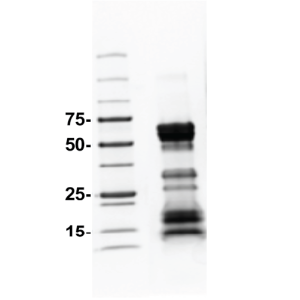
Ara h 1 ELISA 2.0 kit


Price range: $615 through $10,545
ELISA 2.0 kit for measuring Arachis hypogaea allergen, Ara h 1, peanut.
Antibodies: 2C12/2F7
Standard Range: 2,000-4.0 ng/mL
Limit of Detection: 31.5 ng/mL
Background: OD<0.08 at 450nm
Coefficient of Determination: R-squared >0.98
Contents:
Plate: Pre-coated with anti-Ara h 1 monoclonal antibody 2C12
Vial 1: (white top) Ara h 1 allergen standard
Concentration: 20,000 ng/ml
Vial 2: (brown) anti-Ara h 1 antibody 2F7
Vial 3: (blue top) Streptavidin-Peroxidase
Bottle 1: Wash buffer, (10x concentrate)
Bottle 2: Assay buffer, (10x concentrate)
Bottle 3: TMB developing substrate
Bottle 4: Stop solution (0.5N sulfuric acid)
Storage: The ELISA 2.0 kit should be stored at 2-8°C.
Expiry: See product insert.
Not Provided:
Type I ultrapure water or 18.2MΩ de-ionized water
Volumetric measuring equipment (e.g. serological pipette, graduated cylinder)
Clean containers for buffer and reagent preparation
Calibrated single and multi-channel micropipettes and tips
Vortex mixer
Plate reader capable of reading absorbance at 450nm
Analysis software (recommended, but not required)
Notes: The allergen standard is recommended for immunoassay calibration
purposes only.
A list of frequently asked questions and troubleshooting guide can be found under the ‘Support’ tab on our website.
Product Resources:
EPC-AH1 Certificate of Analysis and Protocol
Validation Performance Data
For research and commercial use in vitro: not for human in vivo or therapeutic use.
References:
- Pomés A, Helm RM, Bannon GA, Burks AW, Tsay A, Chapman MD. Monitoring peanut allergen in food products by measuring Ara h 1. J Allergy Clin Immunol 2003;111:640-5.
- Pomés A, Vinton R, Chapman MD. Peanut allergen (Ara h 1) detection in foods containing chocolate. J Food Prot. 2004 Apr:67 (4):793-8.Perry TT, Conover-Walker MK,
- Pomés A, Chapman MD, Wood RA. Distribution of peanut allergen in the environment. J Allergy Clin Immunol. 2004 May;113(5):973-6.
- Maloney JM, Chapman MD, Sicherer SH. Peanut allergen exposure through saliva: assessment and interventions to reduce exposure. J Allergy Clin Immunol. 2006 Sep;118(3):719-24.